
The question isn’t whether you’re ready. It’s whether waiting is actually protecting you, or quietly creating a different kind of pain down the road.
Most families in the Vancouver and Portland area assume the headstone comes last. After the grief settles. After the family agrees. After things feel more normal. That assumption is understandable. It’s also the single most common reason families find themselves scrambling against cemetery deadlines they didn’t know existed.
Direct Answer
Most families can begin the headstone process within four to eight weeks of a loss, not because grief has resolved, but because starting early gives you more time, more design choices, and less pressure. Production typically takes six to twelve weeks depending on complexity. Waiting longer doesn’t make the decision easier; it often makes it harder and more constrained.
When Should You Begin the Memorial Process?
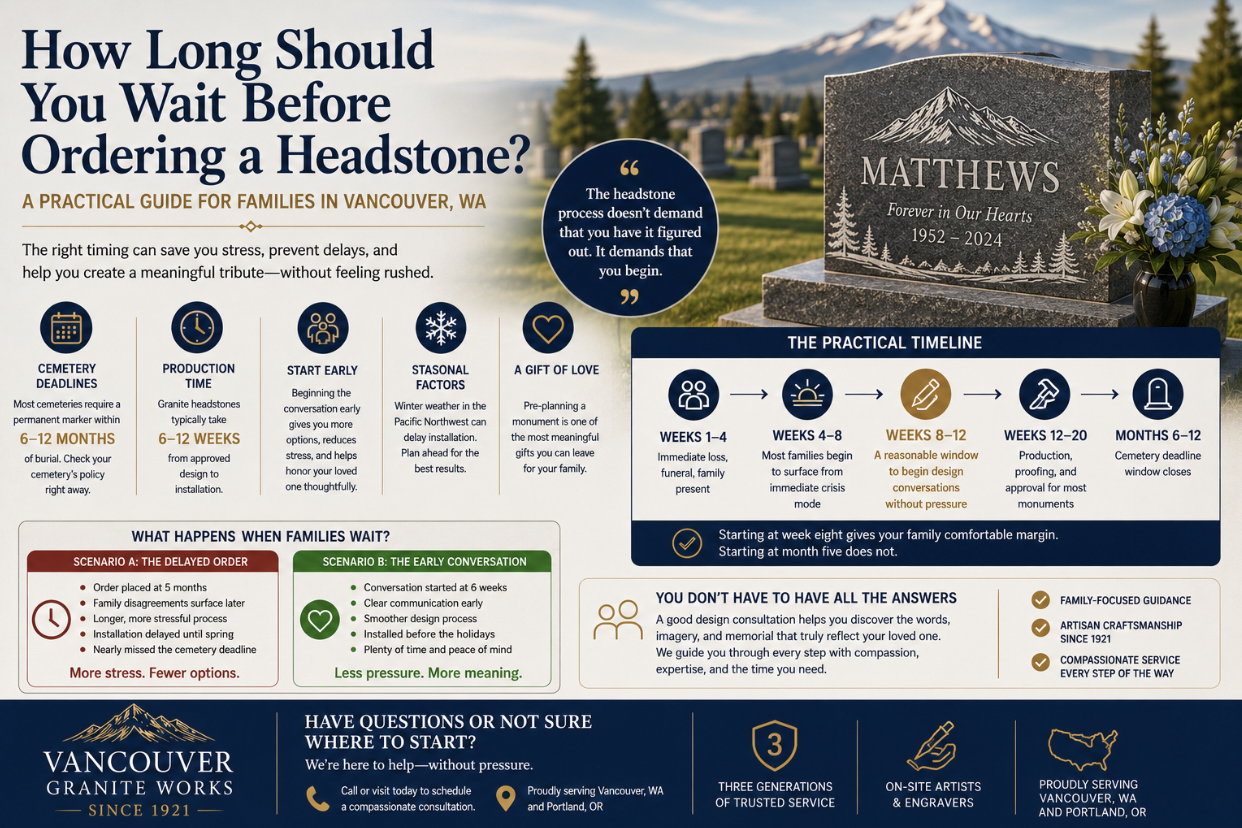
- Most cemeteries in the Vancouver, WA and Portland, OR area require a permanent marker within six to twelve months of burial, check your specific cemetery’s policy immediately
- Granite headstone production typically takes six to twelve weeks from approved design to installation; custom bronze elements can add additional time
- Starting the design conversation early doesn’t rush grief, it gives grief more room to shape the memorial thoughtfully
- Family disagreements about memorial design are significantly harder to resolve under deadline pressure than they are in open-ended conversations
- Seasonal ground conditions in the Pacific Northwest affect installation windows; orders placed in late fall may not install until spring
Why Do Families Wait, and What Does That Waiting Actually Cost?
The instinct to wait comes from a real place. Choosing a headstone feels final in a way that other post-loss tasks don’t. Signing paperwork, notifying accounts, returning phone calls, those feel administrative. Choosing how a person will be remembered for generations feels different.
The problem is that waiting conflates two separate things: emotional readiness and practical readiness. They’re not the same, and treating them as identical is what creates the most avoidable complications.
Emotional readiness, the feeling that you’re at peace enough to make this decision, may take months or years. Practical readiness, having the basic information needed to begin a design conversation, can exist within weeks of a loss.
The cemetery doesn’t wait for emotional readiness. The deadline does.
What Are the Actual Deadlines Families Don’t Know About?
Cemetery deadline policies vary, but most cemeteries in Clark County and the greater Portland metro area require a permanent marker to be in place within six to twelve months of burial. Some allow up to eighteen months; a small number are stricter.
Temporary markers, typically a small metal or plastic stake placed at the time of burial, are not a permanent solution. They’re a placeholder. They fade, shift, and in some cases get removed by cemetery groundskeeping if the permanent marker deadline passes.
Here’s what most families don’t realize: the deadline clock starts at burial, not at the point when you feel ready. If a family waits five months before beginning the process, and production takes ten weeks, they may be cutting very close to a hard deadline, or missing it entirely.
The practical sequence looks like this:
- Weeks 1 – 4: Immediate loss, funeral arrangements, family present
- Weeks 4 – 8: Most families begin to surface from immediate crisis mode
- Weeks 8 – 12: A reasonable window to begin memorial design conversations without pressure
- Weeks 12 – 20: Production, proofing, and approval for most standard granite monuments
- Months 6 – 12: Cemetery deadline window closes
Starting at week eight gives a family comfortable margin. Starting at month five does not.
For families working through how to choose the right upright cemetery headstone for your loved one, understanding this timeline is the first practical step, before material, size, or design decisions even enter the conversation.
The Real Reason Families Wait Too Long
Waiting isn’t laziness or avoidance. It’s a misunderstanding of what the process actually requires.
Most families imagine that ordering a headstone means sitting down with a final, fully-formed vision, knowing exactly what they want, having agreed on every detail, feeling certain. That’s not how the process works at a studio like Vancouver Granite Works. The design conversation is iterative. You don’t need answers at the start. You need to start.
The headstone process doesn’t demand that you have it figured out. It demands that you begin.
This is the root cause of most delayed orders: families are waiting for a moment of clarity that the process itself is designed to help them reach. The design consultation isn’t a test of what you already know, it’s how you discover what matters most.
What Happens When Families Wait: Two Scenarios
Scenario A, The delayed order. A family in the Vancouver area lost a parent in early spring. They agreed to wait until everyone had processed the loss before making memorial decisions. By late summer, roughly five months later, one sibling had moved out of state, another had returned to full-time work, and a third had strong opinions about the design that hadn’t surfaced earlier. What might have been a two-week design conversation became a three-month negotiation conducted over email and phone. The order was placed in November. Pacific Northwest ground conditions delayed installation until March, nearly a full year after the burial, and just inside the cemetery’s deadline.
Scenario B, The early conversation. A family who came to Vancouver Granite Works six weeks after their loss didn’t have everything figured out. They had a few photos, a general sense of the stone color their loved one would have preferred, and a phrase they wanted included. The design process took three weeks of back-and-forth. The monument was installed before summer. The family later said the process itself, the act of choosing, was part of how they grieved. It gave the loss a shape.
The difference between these two families wasn’t the depth of their grief. It was when they started.
Does the Season You Order Actually Matter in the Pacific Northwest?
Yes, more than most families expect.
The Pacific Northwest has a narrow practical installation window. Ground conditions in Clark County and the Portland metro area can make monument installation difficult or impossible during extended wet periods, and some cemeteries restrict installation work during winter months entirely.
| Order Timing | Likely Installation Window | Risk Level |
| Spring (March – May) | Summer of same year | Low |
| Summer (June – August) | Fall of same year | Low |
| Fall (September – October) | Late fall or early spring | Moderate |
| Late fall/Winter (Nov – Feb) | Spring of following year | High, potential 4 – 6 month delay |
This isn’t a scare tactic. It’s a practical reality that families who’ve never navigated this process have no reason to know. A monument ordered in November may not be installed until April, not because of production delays, but because of ground and cemetery conditions.
Seasonal timing in the Pacific Northwest isn’t a footnote in the headstone process. For families with cemetery deadlines, it’s the whole equation.
The Contrarian Truth About “Waiting Until You’re Ready”
Here’s the claim worth sitting with: waiting longer doesn’t produce better memorial decisions, it produces more constrained ones.
When families wait, they often lose design options. Custom granite takes time to source. Specific stone colors have lead times. Bronze portrait medallions require additional production weeks. The families who end up with the most meaningful, personalized monuments are almost always the ones who started early, not because they were less affected by grief, but because they had time to be deliberate.
The families who wait until month five or six are often choosing under deadline pressure, with fewer options and less bandwidth for the back-and-forth that produces a truly personal tribute.
The act of choosing words, selecting an image, deciding what mattered most about a person, that’s not administrative. It’s the beginning of something. And beginning it sooner means doing it with more care, not less.
For families who want to understand the full range of timing considerations before their first conversation, this guide on timing decisions for custom headstones in Vancouver, Washington covers the practical and emotional dimensions in detail.
The Memorial Readiness Framework: A Decision Tool for Families
The Memorial Readiness Framework is a simple two-axis assessment designed to help families determine when to begin the headstone process, not based on emotional state alone, but on the intersection of practical urgency and family alignment.
Use it when you’re unsure whether it’s “too soon” to start.
Axis 1, Practical Urgency (cemetery deadline, seasonal window, family availability)
Axis 2, Family Alignment (rough agreement on type, tone, and key design elements)
- High urgency + high alignment: Start immediately
- High urgency + low alignment: Start the conversation now, even without full agreement, deadline pressure is real
- Low urgency + high alignment: Begin within 60 days; use the time for thoughtful design
- Low urgency + low alignment: Schedule a no-pressure consultation to surface what matters before disagreements harden
Don’t use this framework as a reason to delay. Use it to identify which conversation to have first.
What This Guide Doesn’t Cover, and Who It’s Not For
This article is focused on families navigating loss who haven’t yet started the headstone process. It doesn’t address pre-planning a memorial for yourself or a living spouse, though that’s one of the most thoughtful decisions a person can make, and Vancouver Granite Works works with families on pre-need memorial planning regularly.
It also doesn’t address situations where a family is in active legal dispute over an estate, in those cases, a memorial decision may genuinely need to wait for legal resolution, and no production timeline guidance changes that.
If you’re a funeral director or cemetery administrator looking for production timelines to share with families, the figures in this article reflect typical granite monument timelines in the Pacific Northwest. Custom bronze work, larger estate monuments, or pieces requiring specialty stone sourcing will carry longer lead times.
Frequently Asked Questions
How soon after a funeral is it appropriate to order a headstone?
Most families are ready to begin the design conversation four to eight weeks after a loss, not because grief is over, but because the immediate crisis has stabilized enough to think clearly. There’s no rule that says you must wait, and there’s no rule that says you must act immediately. What there is, is a cemetery deadline, and knowing when that falls should inform your timing.
What if my family can’t agree on the headstone design?
Start the conversation anyway, even without agreement. A design consultation at Vancouver Granite Works isn’t a commitment, it’s a way to surface options and give the family something concrete to respond to. Families almost always find it easier to agree on a design when they’re reacting to real options rather than abstract preferences.
How long does it actually take to make a granite headstone?
For a standard upright granite monument, production typically runs six to ten weeks from approved design to delivery. Complex custom work, detailed portraits, multiple colors of granite, bronze inlays, can extend that to twelve weeks or more. That timeline doesn’t include installation scheduling, which adds additional time depending on cemetery availability and seasonal conditions.
What happens if I miss the cemetery’s deadline for a permanent marker?
Policies vary by cemetery. Some issue formal notices and charge fees; others may remove the temporary marker and require you to coordinate with the cemetery office before installation can proceed. It’s worth calling your specific cemetery to confirm their policy, and then working backward from that date to set your own start timeline.
Is it possible to start the design process before I know exactly what I want?
Yes, and honestly, that’s the most common starting point. Families rarely arrive at Vancouver Granite Works with a complete vision. They arrive with a feeling, a few photos, a phrase, or a material preference. The design process builds from there. You don’t need to know the answer before you begin.
Does it cost more to order a headstone quickly?
Rush fees exist in some cases, particularly if a family needs expedited production to meet a deadline. The best way to avoid them is to start early. Families who begin the process with comfortable margin, ten or more weeks before a deadline, rarely face additional costs for timing.
What’s the difference between a temporary marker and a permanent headstone?
A temporary marker is a small, often metal or plastic placeholder placed at the grave shortly after burial. It serves a locating function, not a memorial function. A permanent granite or bronze monument is designed to last for generations, it carries the full inscription, any custom imagery or artwork, and represents the lasting tribute to a person’s life. Most cemeteries require the permanent marker to be in place within six to eighteen months of burial. Families weighing their options can explore the differences between granite and bronze flat grave markers to better understand which material best suits their needs and cemetery requirements.
Ready to Begin? Here’s What to Do Next
If you’ve been holding off because it didn’t feel like the right time, this is the right time to at least have the conversation.
Vancouver Granite Works has been helping families in Vancouver, WA and Portland, OR through this process since 1921. Our Certified Memorialists understand cemetery requirements across the region, work with families at every stage of readiness, and won’t push you toward a decision before you’re prepared to make it.
Have questions about timing, cemetery requirements, or memorial options? Contact Vancouver Granite Works for a no-pressure consultation. Our experienced memorialists will help you understand your options, your timeline, and what it looks like to begin, without any obligation to decide on the spot.
Call us, stop by, or reach out through our website. The conversation itself costs nothing. The delay might.
About the Author
Joey Fuerstenberg is the Owner and Certified Memorialist at Vancouver Granite Works, a third-generation family-operated memorial company serving the Pacific Northwest since 1921. A past president of the Pacific Northwest Monument Builders Association, Joey brings decades of hands-on experience in custom monument design, cemetery requirements, and compassionate family guidance to every consultation. Vancouver Granite Works serves families throughout Clark County, the greater Portland metro area, and across Washington and Oregon.
