
Grief has a way of making even simple decisions feel impossible, and the question of when to order a headstone sits at the intersection of emotional exhaustion, practical urgency, and a process most families have never navigated before. There’s no single right answer. But there are clear signals that tell you whether waiting is wise or whether delay is quietly working against you.
Direct Answer
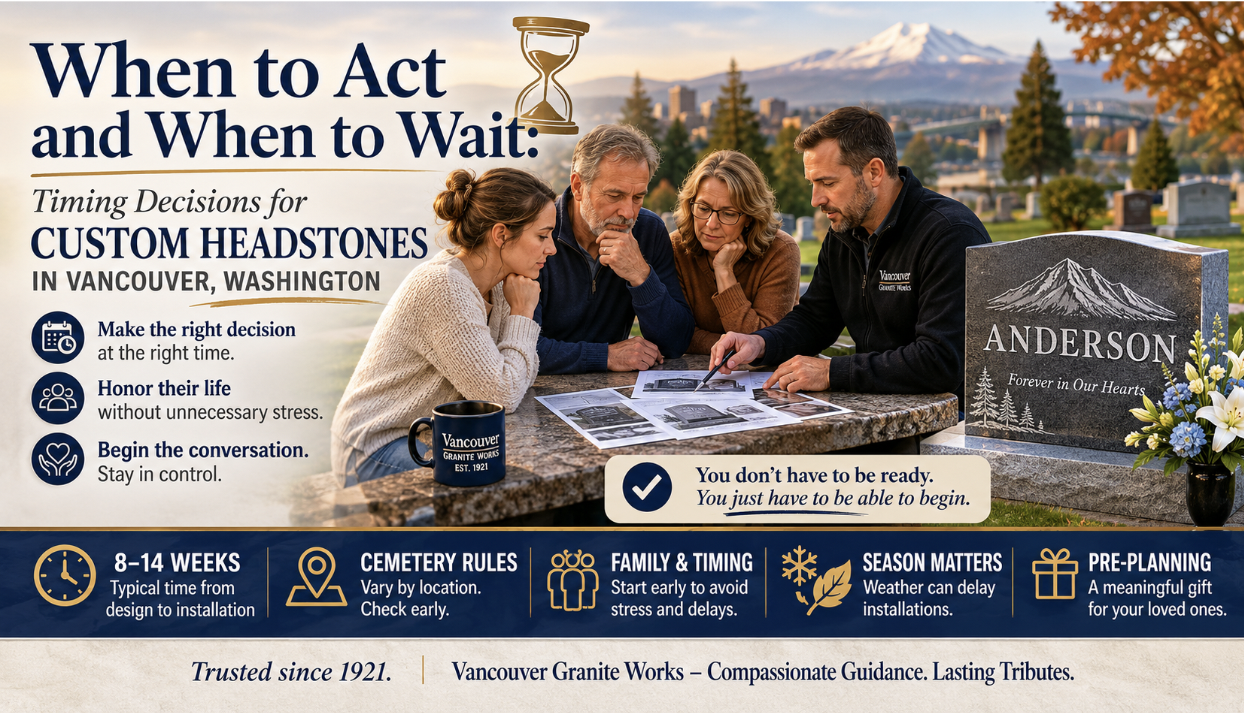
The right time to begin the headstone process depends on three factors: cemetery requirements, your family’s emotional readiness, and material lead times. Most custom granite monuments require 8 – 14 weeks from design approval to installation. Waiting longer than six months after burial risks permit complications at some cemeteries. Starting the conversation early doesn’t mean rushing, it means staying in control.
Key Takeaways
• Most custom granite headstones take 8 – 14 weeks to complete and install after design is finalized, plan accordingly
• Cemetery regulations in the Vancouver, WA and Portland, OR area vary widely; confirm requirements before ordering
• Waiting too long can create permit complications, seasonal installation delays, and emotional drift that makes design decisions harder
• You don’t need to finalize every design detail to start the process, beginning a conversation preserves your options
• Pre-planning a monument for yourself or a spouse is one of the most practical gifts you can leave a family
What Actually Happens If You Wait Too Long?
The real problem isn’t grief. It’s the assumption that waiting feels like respect.
Many families delay ordering a headstone because acting quickly feels disrespectful, as if moving forward means moving on. That instinct is understandable. But the delay itself can create problems that have nothing to do with honoring someone well.
Here’s what practitioners at Vancouver Granite Works observe consistently: families who wait more than a year often face a harder design process, not an easier one. The emotional distance that was supposed to make decisions clearer sometimes makes them murkier. The details that felt too painful to discuss at six weeks become contested at fourteen months, when different family members have formed different ideas about what the memorial should say.
The headstone isn’t the final goodbye. It’s the permanent record of how a life was held.
Why Does the Timing Question Feel So Unclear?
The root cause here isn’t indecision. It’s that no one tells families what the actual timeline looks like, so they don’t know what they’re deciding against when they wait.
Most people assume a headstone can be ordered and installed in a few weeks, the way you’d order something online. The reality is more layered. Custom granite monuments involve design consultation, material selection, proof approval, carving or sandblasting, finishing, and cemetery coordination. Each step has its own timeline. And cemetery rules, which vary by location even within Clark County and Multnomah County, can add additional requirements around monument dimensions, base specifications, and installation scheduling.
When families don’t know this, they delay without realizing the delay has consequences. That’s a systemic gap, not a personal failure.
The Five Timing Signals That Actually Matter
This is where most guides stop at vague advice. Here’s a concrete framework for reading your own situation.
Signal 1: The cemetery has a temporary marker in place.
A temporary marker is a practical placeholder, not a permanent solution. Most cemeteries allow temporary markers for 6 – 12 months. After that, some require action. Check your specific cemetery’s policy, don’t assume.
Signal 2: You can describe the person in two or three sentences.
Design readiness isn’t about being emotionally “over it.” It’s about being able to say who this person was. If you can describe them, their name, their dates, one thing that defined them, that’s enough to begin. The rest of the design process helps families find the rest.
Signal 3: More than one family member is involved in the decision.
When multiple people need to agree, starting early isn’t premature, it’s essential. A family that begins the conversation at eight weeks has time to work through differences. A family that starts at eleven months, with a cemetery deadline approaching, doesn’t.
Signal 4: The season is changing.
Monument installation in the Pacific Northwest is weather-dependent. Frozen or saturated ground can delay installation, particularly from late November through February. If you want a monument in place by a meaningful date, a first anniversary, a spring memorial gathering, work backward from that date, not forward from today.
Signal 5: You’re pre-planning for yourself or a spouse.
Pre-planning is the one timing situation where waiting has almost no upside. Families who receive a pre-planned monument design as part of an estate plan describe it as one of the most meaningful gifts they were given. It removes a decision from the hardest weeks of their lives.
The Contrarian Position on “Waiting Until You’re Ready”
Here it is, stated plainly: waiting until you feel ready is often the worst timing strategy for a headstone.
Readiness, in grief, isn’t a destination. It’s not a state you arrive at after enough time has passed. Families who wait for emotional readiness before beginning the process frequently report that the design conversation itself, working with an experienced memorialist, choosing an image, selecting words, was part of what helped them feel ready. The process doesn’t require readiness. For many people, it creates it.
“The design conversation isn’t something you do after you’ve processed the loss. For most families, it’s part of how the processing happens.”
This is why Vancouver Granite Works approaches the initial consultation as a guided conversation, not a sales transaction. The goal is to help families find the words and images that feel true, and that work happens better with time and guidance than under deadline pressure.
How Long Does the Process Actually Take? Realistic Numbers
Here’s a side-by-side breakdown of what different monument types typically require, from first conversation to installation:
| Monument Type | Design Phase | Production | Installation | Total Typical Range |
| Standard upright granite headstone | 1 – 3 weeks | 6 – 10 weeks | 1 – 2 weeks | 8 – 15 weeks |
| Custom upright with portrait or detailed carving | 2 – 4 weeks | 8 – 12 weeks | 1 – 2 weeks | 11 – 18 weeks |
| Bronze memorial tablet | 2 – 3 weeks | 8 – 10 weeks | 1 – 2 weeks | 11 – 15 weeks |
| Flat granite marker (flush) | 1 – 2 weeks | 4 – 8 weeks | 1 – 2 weeks | 6 – 12 weeks |
| Pre-planned monument (no rush) | Flexible | Standard | Scheduled | Varies by preference |
These are working estimates based on standard conditions. Cemetery approval processes, material availability, and design complexity all affect actual timelines. For families in the Vancouver, WA and Portland, OR area, Vancouver Granite Works coordinates directly with local cemeteries, which removes one of the most common sources of delay.
What This Process Doesn’t Do Well
Honest answer: if a family is in acute crisis, recent loss, significant internal conflict, or a situation where no one has decision-making authority, beginning the monument process immediately can add pressure rather than relieve it.
In those cases, the right move is to confirm the cemetery’s temporary marker policy, note the deadline, and schedule a consultation for 4 – 6 weeks out. That’s not avoidance. That’s triage.
The monument process also can’t resolve family disagreements about how a person should be remembered. If there’s significant conflict about the inscription, imagery, or even whether a monument is the right choice, that conversation needs to happen before the design process begins, not during it.
If you’re in that situation, our complete guide to choosing the right headstone for your loved one includes a section specifically on navigating family decisions, it’s worth reading before your first consultation.
One Scenario That Illustrates the Stakes
A family in the Portland area reached out to Vancouver Granite Works fourteen months after their father’s burial. They’d been waiting until they “felt ready.” By the time they called, the cemetery had sent two notices about the temporary marker, one family member had moved out of state, and the family couldn’t agree on whether to include a religious symbol.
The design process took three months instead of the typical six to eight weeks, not because of production delays, but because every decision had to be made remotely, under pressure, with unresolved disagreement underneath it.
They got there. The monument is beautiful. But the family described the experience as far harder than it needed to be.
Starting earlier wouldn’t have erased the grief. It would have given the grief somewhere to go.
“A headstone isn’t a purchase you make when you’re ready. It’s a conversation you begin when you’re able, and the beginning is usually easier than families expect.”
When Pre-Planning Changes Everything
Pre-planning a monument, selecting your own granite, inscription, and design while you’re healthy, is one of the most underused tools in end-of-life planning. It’s not morbid. It’s practical, and it’s a genuine act of care for the people who will survive you.
Vancouver Granite Works has worked with individuals across Clark County and the greater Portland metro who pre-planned their monuments as part of broader estate arrangements. The design conversations are often the most relaxed and personal ones we have, because there’s no urgency, no grief in the room, and the person can say exactly what they want.
If you’re thinking about sustainable approaches to memorial planning, the principles discussed in the future of luxury stone design and sustainable granite sourcing apply directly to monument selection, material longevity, quarry sourcing, and long-term stone performance all matter when you’re choosing something meant to last generations. Families weighing their options often find it helpful to understand why families choose upright cemetery headstones before committing to a material or style, since monument form affects everything from installation requirements to long-term maintenance.
FAQ
How soon after a burial should I order a headstone?
Most memorial professionals suggest beginning the process within 3 – 6 months of burial. This gives families time to move through the initial shock while still leaving enough runway for design, production, and cemetery coordination before a temporary marker deadline arrives.
Can I start the design process before I know exactly what I want on the headstone?
Yes, and most families should. A good design consultation helps you find the words and imagery, not just execute them. You need a name, dates, and a general sense of the person. The rest develops through the conversation.
What happens if I miss the cemetery’s temporary marker deadline?
Policies vary by cemetery. Some issue notices and work with families on extensions; others may remove the temporary marker or charge fees. Contact your specific cemetery directly to understand their policy, don’t assume a grace period exists.
Is it more expensive to order a headstone quickly?
Rush production is available from some monument companies and typically adds cost. Standard lead times at Vancouver Granite Works are 8 – 14 weeks for most custom granite headstones. Planning within that window avoids rush fees entirely.
What if family members disagree about the design?
Start the conversation early, before it becomes a deadline problem. Vancouver Granite Works works with families through the design process and can present multiple options for review. The more time available, the more room there is to find something everyone feels good about.
Can I pre-plan a headstone for myself while I’m still alive?
Absolutely, and it’s one of the most thoughtful things you can do for your family. Pre-planning allows you to choose your own materials, inscription, and design, and removes a significant burden from the people who will be grieving when the time comes.
Does the time of year affect when a headstone can be installed?
Yes. In the Pacific Northwest, winter conditions, particularly saturated or frozen ground, can delay installation. If you want a monument in place by a specific date, work backward from that date when starting the process. Spring and summer installations are generally the most predictable.
The Signal That Overrides All the Others
You don’t have to be ready. You just have to be able to begin.
That’s the whole framework, compressed. Every other signal, cemetery deadlines, family dynamics, seasonal windows, is downstream of that one. When you can describe the person, you can begin. Everything else is a timeline problem, and timeline problems are solvable.
Vancouver Granite Works has been helping families in Vancouver, Washington and Portland, Oregon work through exactly this process since 1921. If you’re not sure whether now is the right time, that uncertainty is itself a signal worth acting on.
“The families who regret starting too early are rare. The families who regret waiting are not.”
If you’re in the middle of this decision right now, not sure whether to start, not sure what to ask, not sure what you even want, the right next step isn’t to figure it all out first. It’s to have one conversation with someone who’s guided hundreds of families through this exact moment. Call or visit Vancouver Granite Works. You don’t need answers to start. You just need to show up.
About the Author
Joey Fuerstenberg is the owner and a Certified Memorialist at Vancouver Granite Works, a third-generation family-operated memorial company serving the Pacific Northwest since 1921. A past president of the Pacific Northwest Monument Builders Association, Joey has spent his career helping families across Clark County and the greater Portland metro create meaningful, lasting tributes through artisan craftsmanship and personalized design. Vancouver Granite Works remains one of the region’s most trusted full-service monument providers, with on-site artists and engravers and a deep commitment to cultural understanding and compassionate service.
