
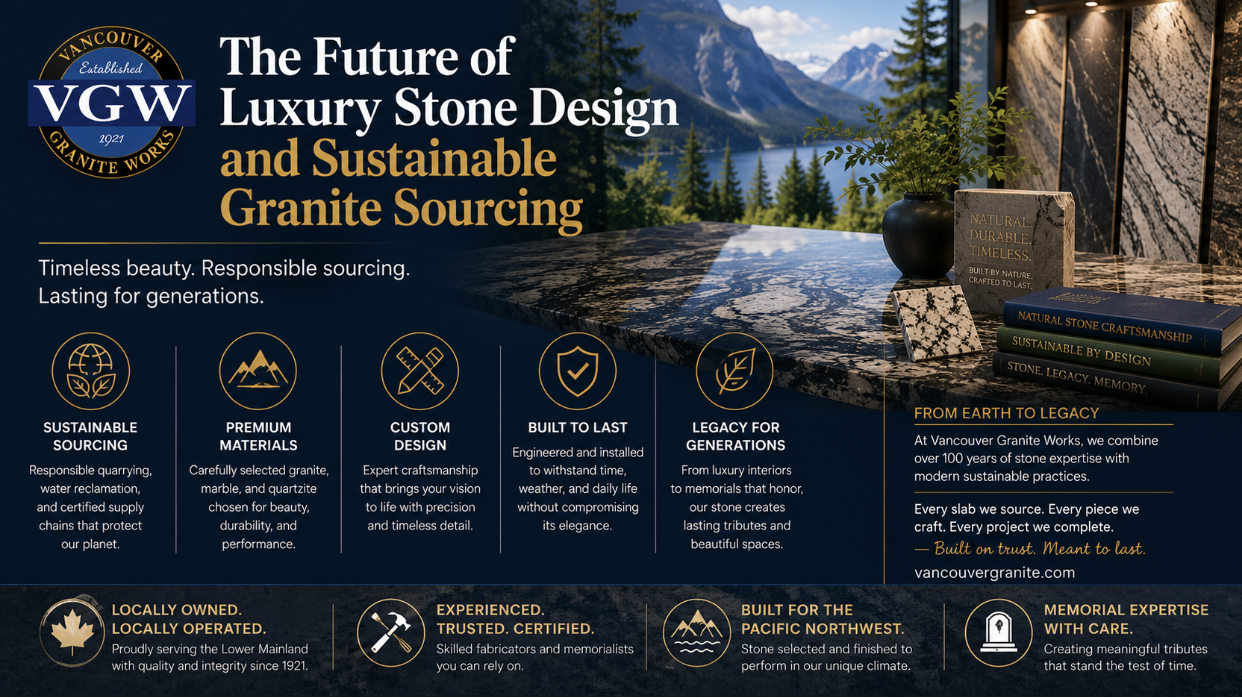
The stone beneath your feet in a quarry in Brazil or India may have formed 300 million years ago. What happens to it next, how it is extracted, transported, shaped, and placed, is now one of the most consequential decisions in premium stone design.
What Is Driving the Future of Luxury Stone Design?
Luxury stone design is the practice of selecting, sourcing, and crafting natural stone, granite, marble, quartzite, and related materials, for applications where aesthetic quality, material integrity, and long-term durability are the primary criteria, not cost minimization. The future of this field is being shaped by two converging forces: rising demand for sustainable sourcing practices and a renewed appreciation for stone as a permanent, irreplaceable material in a world increasingly filled with surfaces that simulate permanence without delivering it.
In short: the next era of premium stone craftsmanship is not about doing more with less. It is about doing the right things with the right materials, traced from origin to final placement.
Key Takeaways
- Sustainable granite sourcing now includes chain-of-custody certification, water reclamation in quarry operations, and reduced transport emissions through regional sourcing. Not just recycled content claims.
- The most durable luxury stone installations share one trait: material selection was made for the specific environment, not the showroom floor.
- Engineered stone surfaces cannot replicate the mineral variation, thermal stability, or compression strength of natural granite. And the gap matters most in permanent applications.
- Families choosing memorial granite benefit from the same sourcing standards used in high-end architectural stone: consistent grain, verified hardness ratings, and weather-tested finishes.
- Vancouver Granite Works applies these sourcing principles directly to memorial design, drawing on over a century of material knowledge to match stone quality to the Pacific Northwest’s specific climate conditions.
Understanding Sustainable Granite and Material Excellence
This is the most common misconception in the category, and it deserves a direct answer.
Granite being natural does not make its extraction automatically sustainable. The quarrying process, drilling, blasting, cutting, and transporting stone blocks that can weigh several tons, is energy-intensive and, when poorly managed, environmentally disruptive. Water use in cutting and polishing operations is significant. Transportation from overseas quarries adds a carbon footprint that many buyers never consider when they select a stone based on color samples alone.
Responsible quarry operations now use water reclamation systems that recycle up to 90% of cutting water, according to industry reporting from the Natural Stone Institute. Dust suppression, land restoration plans, and third-party audits are becoming standard practice among certified suppliers. Not optional additions.
The question is not whether granite is natural. The question is whether the supply chain that brought it to you treated the land, the water, and the workers with the same permanence the stone itself promises.
For families selecting memorial granite, this matters beyond environmental ethics. Stone sourced through verified supply chains comes with consistent quality documentation, hardness ratings, porosity data, finish stability, that directly affects how a headstone or monument holds up over decades of Pacific Northwest weather.
What Are the Defining Luxury Stone Design Trends Shaping 2026?
Several shifts are redefining what “premium” means in stone design right now.
Quartzite is displacing marble in high-use applications. Marble’s aesthetic appeal has never been in question, but its softness, typically rating 3-4 on the Mohs hardness scale, makes it vulnerable to etching and surface degradation in outdoor and high-traffic environments. Quartzite, which rates 7 or higher, delivers similar visual depth with significantly greater durability. Practitioners working in both architectural and memorial stone report increasing client preference for quartzite where longevity is the priority.
Bookmatched stone panels are moving from hospitality interiors into residential and memorial applications. Bookmatching, the practice of opening two adjacent slabs like a book to create a mirrored natural pattern, was previously reserved for luxury hotel lobbies and high-end commercial interiors. The technique is now appearing in custom memorial design, where the symmetry creates a visual weight and intentionality that standard single-slab applications cannot replicate.
Textural contrast is replacing uniform polish as the signature of premium work. A decade ago, a fully polished granite surface signaled quality. Now, the most sophisticated stone work combines polished faces with honed, sandblasted, or flamed textures within a single piece. The contrast draws the eye, adds dimensional depth, and, critically, demonstrates the craftsman’s confidence in the material itself.
At Vancouver Granite Works, on-site artists have been applying this principle to memorial design for years: combining polished portrait panels with textured stone bodies to create visual hierarchy that honors the subject rather than simply displaying the stone.
Does Durable Stone Actually Cost Less Over Time. Or Is That Just a Sales Claim?
It is not a sales claim. It is material science.
The real cost of stone is not the purchase price. It is the replacement cost multiplied by the number of times you replace it. Engineered stone surfaces, composite materials, and lower-grade granite all carry lower upfront costs. They also carry replacement cycles measured in years rather than generations.
Consider a documented pattern in architectural stone specification: a regional contractor who switched from imported low-grade granite to domestically sourced, higher-hardness stone for outdoor commercial applications reported eliminating resurfacing costs entirely over a seven-year period. Costs that had previously run on a 24-month cycle. The material cost differential was recovered within the first replacement cycle that never happened.
For memorial applications, this calculus is even more direct. A headstone or monument is placed once. It is expected to remain legible, structurally sound, and visually intact for generations. The Pacific Northwest’s freeze-thaw cycles, moss growth conditions, and rainfall levels are not gentle on porous or low-hardness stone. Selecting the right material at the outset is not a luxury decision. It is the only practical one.
Natural granite rated at 6-7 on the Mohs hardness scale, properly sealed and finished, does not degrade on a human timescale. That is not a marketing claim. That is geology.
The Provenance-to-Permanence Framework: How Should Families and Designers Evaluate Stone Quality?
The Provenance-to-Permanence Framework is a four-stage evaluation model for assessing whether a natural stone selection will perform as intended over its expected lifespan.
Stage 1. Origin Verification. Where was the stone quarried? Is the quarry certified by a recognized body such as the Natural Stone Institute’s Sustainability Certification program? Can the supplier provide chain-of-custody documentation?
Stage 2. Material Specification. What is the stone’s Mohs hardness rating? What is its water absorption rate? Has it been tested for freeze-thaw resistance? These are not obscure technical details. Reputable suppliers provide them.
Stage 3. Finish Compatibility. Is the chosen finish appropriate for the installation environment? A high-polish finish on a north-facing outdoor surface in a wet climate will show weathering faster than a honed or flamed finish on the same stone.
Stage 4. Craftsman Qualification. Who is cutting, shaping, and finishing the stone? On-site fabrication by experienced artisans, rather than outsourced cutting with local assembly, preserves material integrity and allows real-time quality decisions.
Use this framework when: selecting stone for any permanent outdoor application, memorial installation, or architectural feature expected to last 25+ years without resurfacing.
Do not apply it when: selecting decorative interior stone for short-term residential renovation where aesthetic preference outweighs longevity requirements.
What Are the Genuine Limitations of Natural Stone. And When Is It the Wrong Choice?
Natural stone is not the right answer for every application. Saying otherwise would be dishonest.
Stone is heavy. Installation requires structural preparation that synthetic surfaces do not. In renovation contexts where subfloor load capacity is limited, large-format granite slabs may not be feasible without engineering modifications.
Stone is not uniform. The same quarry produces slabs with variation in veining, color, and mineral distribution. For clients who require exact color matching across large installations, this variability is a functional limitation, not just an aesthetic one.
And stone is not forgiving of poor specification. Placing a soft marble in a high-traffic outdoor environment, or selecting a highly porous granite for a wet-climate memorial without proper sealing, produces accelerated degradation that reflects poorly on the material when the real failure was in the selection process.
The families and designers who get the most from natural stone are those who treat material selection as a technical decision, not just an aesthetic one. That is where working with an experienced, knowledgeable supplier, one who asks about your environment and use case before recommending a stone, makes a measurable difference. Families navigating these decisions for the first time may also find it helpful to understand why families choose upright cemetery headstones as a starting point for thinking through both material and form together.
Comparison: Natural Granite vs. Engineered Stone vs. Composite Markers
| Criteria | Natural Granite | Engineered Stone | Composite/Synthetic |
| Mohs Hardness | 6-7 | 5-6 (varies by binder) | 2-4 |
| Lifespan (outdoor) | 100+ years | 20-40 years | 10-20 years |
| Freeze-thaw resistance | High (dense, low porosity) | Moderate | Low |
| Engraving precision | Excellent | Moderate | Poor |
| Environmental sourcing | Certifiable (NSI standards) | Mixed (resin binders) | Variable |
| Color consistency | Natural variation | High consistency | High consistency |
| Memorial suitability | Preferred standard | Limited | Not recommended |
The tradeoff is clear: engineered and composite surfaces offer consistency and lower upfront cost. Natural granite offers permanence. For applications where permanence is the point, a memorial, a landmark installation, an architectural feature meant to outlast its creators, the tradeoff is not a close call. Families comparing options across monument styles may also want to review the differences between granite vs. bronze flat grave markers before finalizing a material decision.
FAQ
How do I know if the granite being used for a headstone is actually high quality?
Ask your supplier for the stone’s Mohs hardness rating and water absorption rate. Reputable memorial companies can provide this. Visual inspection alone is not sufficient; a stone can look polished and still be porous enough to absorb moisture and degrade in wet climates. Vancouver Granite Works sources granite specifically rated for Pacific Northwest outdoor conditions.
Is sustainable granite sourcing more expensive than standard sourcing?
In many cases, the cost difference is smaller than buyers expect, and in some regional sourcing scenarios, it is negligible. The larger cost factor is transportation distance. Domestically quarried stone often costs less to ship than imported material, which partially offsets any premium for certified sustainable extraction.
How long does a properly installed granite headstone actually last?
A granite headstone fabricated from dense, low-porosity stone, properly finished and installed, is expected to remain structurally sound and legible for well over a century under normal conditions. The Pacific Northwest’s climate is demanding, but granite rated at 6-7 Mohs with a proper sealant application handles freeze-thaw cycles without surface degradation.
What is bookmatching and does it apply to memorial stone design?
Bookmatching is the technique of cutting two adjacent stone slabs and opening them symmetrically to create a mirrored natural pattern. It is increasingly used in custom memorial design for companion monuments and larger family markers, where the visual symmetry adds intentionality and artistry to the finished piece.
Can I request a specific stone origin for a memorial. Like a family’s home country?
Yes, and this is more common than most families realize. Many memorial companies, including Vancouver Granite Works, can source granite from specific regions, India, Brazil, Scandinavia, China, where the stone carries personal or cultural significance for the family. Lead times vary, but the option exists and is worth asking about.
What finish is most appropriate for an outdoor memorial in the Pacific Northwest?
A polished face is standard for the primary inscription panel because it maximizes engraving legibility and resists moss adhesion better than rough textures. However, combining a polished front with a honed or thermal-finish back and sides reduces the overall surface area that collects moisture. A practical choice for the region’s rainfall levels.
How do I evaluate a memorial company’s stone sourcing practices before committing?
Ask directly: Where does your granite come from? Can you provide hardness and porosity specifications? Do you fabricate on-site or outsource cutting? A company with genuine sourcing knowledge will answer these questions specifically. Vague answers about “quality stone” without technical detail are a signal worth noting.
Ready to Explore Premium Granite and Stone Options?
If this article has shifted how you think about stone, not as a surface choice but as a material commitment, that is the right place to be before making a permanent decision.
Vancouver Granite Works has been selecting, sourcing, and crafting memorial granite in the Pacific Northwest since 1921. Every piece is fabricated on-site by artisans who understand both the material and the moment it is meant to mark. Families throughout Vancouver, Washington and the Portland, Oregon area trust that combination of knowledge and care because it shows in the finished work. And because it lasts.
Explore premium granite and stone options with a team that has spent a century learning what permanence actually requires. Contact Vancouver Granite Works to begin a conversation about your memorial design. At your pace, with no pressure, and with the full benefit of three generations of material expertise behind every recommendation.
About the Author
Joey Fuerstenberg is the Owner and Certified Memorialist at Vancouver Granite Works, a third-generation family-operated memorial company serving the Pacific Northwest since 1921. A past president of the Pacific Northwest Monument Builders Association, Joey has spent his career combining artisan craftsmanship with practical material knowledge to help families create lasting tributes. Under his leadership, Vancouver Granite Works has grown into one of the region’s most trusted full-service monument providers, serving families throughout Washington and Oregon.
References
Natural Stone Institute. Industry standards for sustainable quarry certification, chain-of-custody documentation, and stone performance specifications.
Mohs Hardness Scale. Mineralogical standard for measuring scratch resistance in natural and engineered stone materials, widely used in architectural and memorial stone specification.
Pacific Northwest Monument Builders Association (PNMBA). Regional professional organization for monument builders and memorial craftspeople in Washington and Oregon.
