
Grief has a way of making even simple decisions feel impossible. And choosing a headstone is
not a simple decision. It is permanent, public, and deeply personal, often made during the
hardest weeks of a family’s life.
Choosing a headstone means selecting the material, shape, size, inscription style, and design
that will represent your loved one at their resting place. For generations. Most families choose
upright granite monuments for their durability and design flexibility. The right choice depends on
cemetery regulations, your budget, cultural preferences, and what best captures the person you
are honoring.
Key Takeaways
- Upright granite headstones are the most common and design-flexible option. Not flat markers, which serve a different purpose
- Cemetery regulations govern size, material, and installation requirements before any design begins
- Granite color and finish affect both aesthetics and long-term legibility of engravings
- Custom design elements, portraits, symbols, cultural motifs, are achievable without requiring a large budget
- Working with a Certified Memorialist ensures your design meets both cemetery standards and your family’s intentions
Why Does Choosing a Headstone Feel So Overwhelming?
Most families have never done this before. That is the honest answer.
Unlike other major purchases, there is no rehearsal. You are navigating unfamiliar terminology, upright, base, tablet, slant marker, bevel, while simultaneously managing grief, family dynamics, and time pressure from the cemetery. The process feels bureaucratic precisely when it should feel human.
The real problem is not the number of choices. It is that families do not know which choices actually matter.
Granite color? Matters. Finish type? Matters significantly. The exact wording on the inscription? Matters forever. Whether the base has a certain edge profile? Probably not worth losing sleep over.
At Vancouver Granite Works, families who come in having done some research often arrive with the wrong questions. Focused on minor aesthetic details while unaware that their chosen cemetery has a 48-inch width restriction that eliminates half the designs they liked online. Start with the cemetery. Everything else follows.
Understanding Your Headstone Design Options
The memorial industry uses inconsistent terminology, which creates confusion early. Here is a working definition for each primary type:
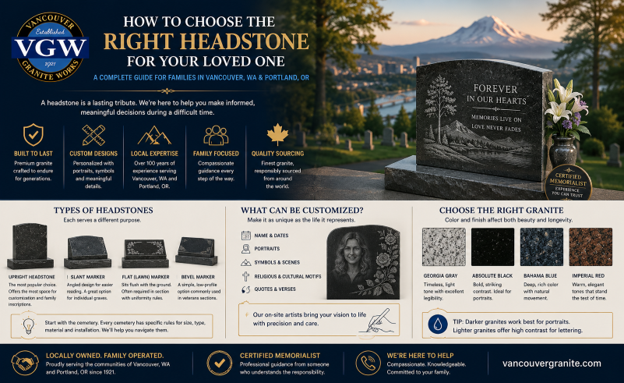
An upright headstone is a vertical granite monument set into a base, standing above ground level. The most recognized form of cemetery memorial.
A flat marker (also called a lawn-level marker) lies flush with the ground.
A slant marker sits at an angle, offering a middle ground between the two.
| Type | Height | Design Flexibility | Typical Use Case | Cemetery Restrictions |
| Upright Headstone | 18″ – 36″+ | Highest | Primary memorial, family plots | Some sections prohibit |
| Slant Marker | 8″ – 16″ | Moderate | Individual graves, budget-conscious | Some sections prohibit |
| Flat/Lawn Marker | Flush | Limited | Sections requiring uniformity | Required in some areas |
| Bevel Marker | 6″ – 8″ rise | Low-moderate | Veterans sections, simple tributes | Some sections prohibit |
Upright headstones remain the primary product at Vancouver Granite Works. And for good reason. They offer the most surface area for custom design, portrait engravings, cultural symbols, and multi-generational family inscriptions. They are also what most families picture when they imagine a meaningful, lasting tribute. If you are weighing the options, understanding why families choose upright cemetery headstones can help clarify whether this style is right for your situation.
The headstone is not just a marker. It is the only permanent, public statement a family makes about who their loved one was. And it will outlast every eulogy ever spoken.
How Do You Choose the Right Granite Color and Finish?
Granite color is not purely aesthetic. It directly affects the legibility of engravings over decades.
Light-colored granites, like Georgia Gray or Silver Cloud, show sandblasted artwork and lettering with high contrast. Dark granites, like Absolute Black or Academy Black, are ideal for laser-etched portraits and photographic imagery because the etching reveals lighter tones within the stone. Mid-tone granites like Bahama Blue or Imperial Red offer visual distinction and hold up exceptionally well in the Pacific Northwest’s wet climate.
Finish type matters as much as color. A polished finish reflects light and makes colors vivid. It is the standard for the front face of most upright headstones. A honed or thermal finish creates a matte surface often used on sides and backs. Rough-pitched edges give a natural, uncut appearance that some families prefer for its organic quality.
One practical scenario: a family selecting a dark granite with a polished front face for a portrait engraving will see that portrait remain legible and visually striking for 50 or more years with minimal maintenance. The same portrait etched into a light granite with a honed finish will fade into the background within a decade.
The mechanism here is simple. Contrast is what makes engraved imagery readable at distance and over time. Granite selection is not decoration. It is a legibility decision.
What Can Actually Be Customized on a Headstone?
More than most families realize. Far less than some online vendors imply.
Custom headstone design is the area where working with on-site artists, rather than ordering through a catalog, makes the most tangible difference. At Vancouver Granite Works, the design process begins with a conversation about the person being honored: their interests, their cultural background, their faith, their relationships. The headstone design emerges from that story.
Achievable customizations include:
- Portrait engravings from a photograph, laser-etched directly into the granite surface
- Cultural and religious symbols. Crosses, Stars of David, Buddhist imagery, Indigenous motifs, and others
- Custom shapes. Arched tops, heart shapes, book-style monuments, and more
- Epitaphs and inscriptions in any language, including non-Latin scripts
- Vase attachments, flower saddles, and granite benches for family plots
The honest limitation: some customizations require cemetery approval before fabrication begins. A design that includes a certain height, shape, or attached element may be rejected by the cemetery’s monument regulations. This is why the design process at Vancouver Granite Works always begins with a review of the specific cemetery’s requirements. Not after the family has fallen in love with a design that cannot be installed.
Custom design is not about adding decoration. It is about making the memorial specific enough that no one could mistake it for anyone else’s.
Does Granite Quality Vary. And How Would You Even Know?
Yes. Significantly. And most families cannot tell the difference by looking.
Granite is graded by quarry origin, mineral density, and consistency of color pattern. Lower-grade granite may contain natural fissures or inconsistent mineral distribution that affects how it holds an engraving over time. Higher-grade granite, the kind used in quality monuments, is denser, more uniform, and more resistant to the freeze-thaw cycles that characterize Pacific Northwest winters.
This is the contrarian claim worth stating plainly: the cheapest headstone is rarely the most economical choice over a 50-year horizon. A monument that requires re-engraving because the granite surface has spalled, or that shifts because the base was undersized, costs more in the long run. And causes families to revisit a painful decision years later.
Practitioners in the monument industry commonly observe that families who prioritize upfront cost savings over material quality are more likely to return within 10-15 years for repairs or replacement. That pattern is not inevitable. It is a direct consequence of granite grade and installation quality.
Vancouver Granite Works has been selecting granite from trusted quarry sources since 1921. That continuity of supplier relationships is not a marketing point. It is how quality control actually works in this industry.
What Does the Process Look Like From First Conversation to Installation?
Understanding the timeline reduces anxiety. Here is a realistic sequence:
Week 1-2: Initial consultation, cemetery regulation review, design concept development. Families bring photographs, notes about their loved one, and any cultural or religious preferences.
Week 2-4: Design approval, material selection, proof review. The family approves a final design rendering before fabrication begins.
Week 4-10: Fabrication and engraving. Custom monuments with portrait work or complex designs take longer than standard inscriptions.
Week 10-14: Cemetery coordination and installation. The cemetery schedules the installation; Vancouver Granite Works handles the logistics.
Most families are surprised that the process takes 10-14 weeks from first consultation to installed monument. That timeline is not a delay. It is what quality fabrication requires. Vendors promising 3-4 week turnarounds on custom granite monuments are typically cutting steps in the design or material sourcing process.
A headstone installed in 30 days is not a fast headstone. It is a headstone where someone rushed a decision that will stand for a century.
Is This the Right Approach for Every Family?
No. And that is worth saying directly.
Families who need a simple, budget-conscious flat marker for a section of the cemetery that requires lawn-level monuments have different needs than families commissioning a custom upright monument with portrait engraving. Both are valid. Both deserve the same level of care in the design process. If you are considering a lawn-level option, it helps to understand what flat grave markers are and how they differ from upright monuments before making a final decision.
This guide is primarily oriented toward families selecting upright headstones or custom monuments. The most common request at Vancouver Granite Works. If your cemetery requires a flat marker, or if your budget requires a simpler solution, the same principles of material quality and design intentionality apply. The scope is just different.
What this guide does not cover: pre-need monument planning (purchasing a monument before a death occurs), military headstone applications through the Veterans Benefits Administration, or mausoleum crypt markers. Each of those involves distinct processes worth a separate conversation.
Frequently Asked Questions
How much does a custom granite headstone actually cost in the Vancouver, WA area?
Most custom upright granite headstones range from roughly $2,000 to $10,000 or more depending on size, granite grade, design complexity, and installation. A standard single upright monument with basic inscription sits toward the lower end; a large family monument with portrait engraving and custom shape sits toward the higher end. Vancouver Granite Works works with families across that full range and will give you an honest estimate based on what you actually need.
Do I have to buy the headstone through the cemetery?
No. In most cases, families are free to work with an independent monument company like Vancouver Granite Works. Cemeteries may require that installation be performed by an approved installer, but they cannot typically require you to purchase the monument from them. Always confirm your specific cemetery’s policies before assuming.
How long does granite engraving last before it needs to be redone?
High-quality granite engraving on properly graded stone lasts 50 to 100 years or more without requiring re-engraving. The key variables are granite grade, finish type, and the depth of the original engraving. Shallow engravings on lower-grade granite in high-moisture climates like Portland and Vancouver can show wear within 20-30 years.
Can we add a spouse’s name to a headstone that has already been installed?
Yes, in most cases. Adding a second inscription to an existing monument is called a “companion addition” and is one of the most common services at Vancouver Granite Works. The monument is typically removed, the new inscription is added in the shop, and the monument is reinstalled. The process takes several weeks.
What if I do not know what to put on the headstone?
That is more common than families expect. A Certified Memorialist, like those at Vancouver Granite Works, is trained specifically to help families work through inscription choices, including epitaphs, symbols, and design elements. You do not need to arrive with a finished idea. You need to arrive with what you remember about the person.
Are there headstone options that reflect specific cultural or religious traditions?
Yes. Vancouver Granite Works has experience designing memorials that reflect a wide range of cultural backgrounds, religious traditions, and linguistic preferences, including non-English inscriptions. Cultural specificity in memorial design is not an add-on. It is central to what makes a memorial meaningful.
What happens if the cemetery rejects the design after we have already approved it?
A reputable monument company reviews cemetery regulations before the design is finalized. Not after. At Vancouver Granite Works, cemetery compliance review is part of the design process, not an afterthought. If a cemetery has specific restrictions, those are identified in the first consultation so the design is built around them from the start.
Ready to Begin? Here Is the Right Next Step.
You have read this far because you are trying to do right by someone you love. That matters.
The next step is not browsing a catalog or comparing prices online. It is a conversation. One where you can describe the person you are honoring, ask the questions that are still unclear, and leave with a realistic picture of what is possible.
Vancouver Granite Works has been guiding families through this process since 1921. Our on-site artists, Certified Memorialists, and design team are here to help you create a memorial that is specific, lasting, and worthy of the person it represents.
Schedule a free consultation with Vancouver Granite Works. Bring a photograph. Bring your questions. We will handle the rest.
Contact Vancouver Granite Works
About the Author
Joey Fuerstenberg is the Owner and Certified Memorialist at Vancouver Granite Works, a third-generation family-operated memorial company serving the Pacific Northwest since 1921. A past president of the Pacific Northwest Monument Builders Association, Joey has spent his career combining artisan craftsmanship with compassionate family guidance across hundreds of custom memorial projects. Under his leadership, Vancouver Granite Works has grown into one of the region’s most trusted full-service monument providers, serving families throughout Vancouver, Washington and Portland, Oregon.
References
Monument Builders Association (MBA). Industry organization governing monument standards and Certified Memorialist credentialing in North America.
Veterans Benefits Administration, U.S. Department of Veterans Affairs. Administers the National Cemetery Scheduling Office and provides headstones and markers for eligible veterans; relevant to military monument applications referenced in limitations section.
